
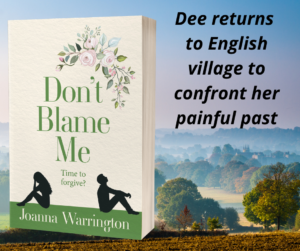
 ‘Don’t Blame Me’ is my latest – soon to be released – novel. It’s a family saga about a woman returning to her childhood home to help her dad who is dying. She hasn’t been back in twenty-five years and is scared to confront the tragedies of her past. But the one person she does not want to see is also staying in the village.
I started writing the novel in February, long before the coronavirus had officially escaped out of China and barely talked about in social circles here in England. Originally I planned to write a family saga about a slaughterer and his daughter, having listened to an interesting piece on Radio 4 about the devastating impact on peoples’ mental health from working in abattoirs.
When lockdown arrived I was up to chapter 5 and about to visit an abattoir in Kent to chat to the owner as part of my research. With world events moving fast and the story of the coronavirus gathering pace, like everyone else I found myself gripped to the news and started to keep a diary of events and my thoughts on what was happening. The 23rd March arrived. Several weeks of solitary confinement loomed ahead presenting a fantastic opportunity to bash ahead with my new novel. But by this time I had lost interest in the abattoir theme. I was so caught up in the virus story and wondering how government measures were going to affect individuals, society and the economy. The situation was going to affect each of us in very diverse ways. Nothing like this had ever happened before in my lifetime. I carried on with the initial theme of my novel – a woman returning to the Kent village where she grew up to confront her painful past, but dropped the abattoir theme and decided to set the novel in the lockdown so that this could form the backdrop.
All the wonderful scenes I saw during lockdown: children playing hopscotch in the road, no planes in the skies, a man walking down the street in a plastic greenhouse and another in a Spiderman mask for protection, feature in the novel.
The novel is set in the Kent village where I grew up but I’ve given it a fictitious name. The house in the novel was inspired by my childhood home. (see below). I’ve lived in so many houses since childhood but in my head, Heatherly, (the house in the novel) is my home and where my heart belongs. The real Heatherly was stunningly beautiful. At the front of the house there was a large allotment when we moved in, in the 1980s, and my parents worked hard to transform it into a rose garden. To the rear of the house my parents had a lake created with an island and a bridge. The house was built in 1270 and has appeared in several books on architecture and the history of homes. The village has barely changed since I grew up there in the 1970s. The River Medway runs through the fields around the village, dotted with pillboxes from the Second World War. The novel primarily is a story about a woman confronting some horrific events in her past but woven through are my nostalgic images of my own childhood village.
We couldn’t go anywhere during lockdown apart from the supermarket. But I needed to make notes of all the flowers and plants along the river so that my descriptions were authentic and accurate. As soon as we were allowed to, I drove to the village to walk through the fields making notes and sketches of the flowers and plants I saw in order to weave through the novel. I wanted the reader to live and breath the surroundings.
I don’t want to give too much away but I hope this has given you some idea of the setting for my new novel!
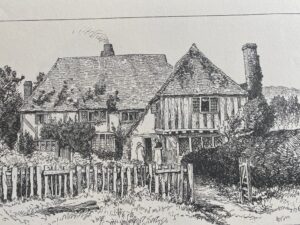
The house where I grew up, my inspiration for the novel’s setting
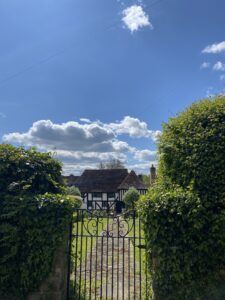
My childhood home, the inspiration for my latest novel, Don’t Blame Me.’